

Two Point Studios has reached a rare milestone: a decade in business while remaining focused on specialised management simulations. The team behind Two Point Hospital and Two Point Museum began with an approximately 18-month agreement with Sega in 2016. Ten years later, it is still operating as one of Sega’s key first-party studios.
Founders Gary Carr and Ben Hymers, alongside COO Jo Koehler, describe a company built around a simple idea: a small, experienced team can make ambitious niche games without losing its creative character. That approach has become increasingly unusual during a difficult period for the games industry, particularly for studios working between small independent projects and major blockbusters.

From Lionhead prototypes to a new studio
Two Point’s roots reach back to the final years of Lionhead Studios, the developer known for the Fable series. Carr and Hymers had previously worked together on projects including The Movies, Lionhead’s studio-management game. Carr later approached Hymers about forming a new company outside Lionhead.
Hymers had a strong appreciation for the Bullfrog games Carr had helped create, including Theme Hospital. He repeatedly questioned why that style of simulation had disappeared. The commercial answer seemed clear to the management teams approving new Xbox projects: management games were not viewed as large enough bets.
Carr recalled pitching simulation concepts at Microsoft, where the emphasis was on billion-dollar franchises and the revenue supposedly being left behind by smaller games. That response discouraged him, while Hymers remained convinced that nostalgia combined with accessible management gameplay still had an audience.
The idea initially even made Carr doubt the genre’s future. After years in the industry, he felt removed from ordinary players’ changing tastes. Hymers and fellow founder Mark Webley eventually persuaded him that the market might be overlooking a valuable audience.
Sega was looking for a studio like Two Point
The founders positioned Two Point as a developer operating below the AAA tier, with the freedom to make the kind of games they wanted to play. The first result was Two Point Hospital, a spiritual follow-up to Bullfrog’s 1997 classic Theme Hospital.
The timing suited Sega’s Searchlight programme, which was designed to find smaller independent teams capable of complementing the publisher’s larger releases. Carr later learned that Sega representatives had been discussing how useful it would be to have a Bullfrog-like studio in the company’s portfolio shortly before Two Point made contact.
Two Point also benefited from the closure of Lionhead in 2016. While negotiations with Sega were under way, Carr, Hymers and Webley could draw from a group of developers who already knew one another and understood simulation games. Carr also brought in Jo Koehler, whose previous production work included EA and Playsport, the developer of Motorsport Manager.
Development began with six people. By the time Two Point Hospital launched, the team had grown to 14. Familiarity and experience helped the project move smoothly, with a shared creative direction and little need for heavy processes or extensive documentation.

Two Point Hospital changed the company’s future
The developers approached Hospital as a chance to return to the playful, characterful design of their earlier careers. They were not working from an established audience profile, so the team could experiment freely and focus on making a detailed simulation that remained inviting.
Two Point Hospital launched in August 2018. Carr expected the studio might last only as long as Sega continued funding it, perhaps two years. Instead, the game reached number one on Steam in more than 40 territories, despite launching alongside major releases such as Madden NFL 19, Overcooked 2 and Monster Hunter: World.
The result surprised the entire team. Their financial forecast allowed roughly 18 months to recover development costs, but Sega’s advances were repaid in two and a half days. That immediate success also meant Two Point entered profitability at the moment when many developers are most financially exposed: after spending their production budget and releasing the game.
The game performed especially strongly in China, Germany, the United States and the United Kingdom. Those results were unexpected because similar simulations had historically struggled in China and Germany, while Theme Hospital had sold less strongly in the United States than in the United Kingdom.

From one game to a Sega first-party studio
The original agreement covered the initial release and did not include a clear plan for future work. After launch, Two Point spent several months fixing bugs, studying player feedback, answering community questions and deciding what came next. Sega amended the arrangement, allowing the team to continue expanding Hospital.
Across the following four years, Two Point released several free updates and paid expansions. It also began planning a second project, Two Point Campus. The sudden success created outside interest in the previously little-known independent studio, but Sega wanted to retain the team and Two Point valued the support it had received.
The publisher had provided funding without demanding ownership of the intellectual property Two Point created. In return, the studio declined other approaches and joined Sega as a first-party developer.
Hospital honoured an older style of game, but Campus gave the studio an opportunity to establish its own setting. Webley’s view was that any subject could work if players felt a personal connection to it. Almost everyone has experience with education, while college management had rarely been explored by other developers.

Listening to players without losing the studio’s identity
Lessons from Hospital shaped the development of Campus and later Two Point Museum. Koehler led work to organise post-launch feedback, identify small sources of frustration and understand which type of simulation player the studio was attracting.
Two Point also improved its technical foundations by developing console versions alongside PC releases. Interface layouts and button placement received particular attention. New systems gave simulated characters more individuality, including Campus notifications that let players follow favourite students and teachers, track their progress and see relationships develop.
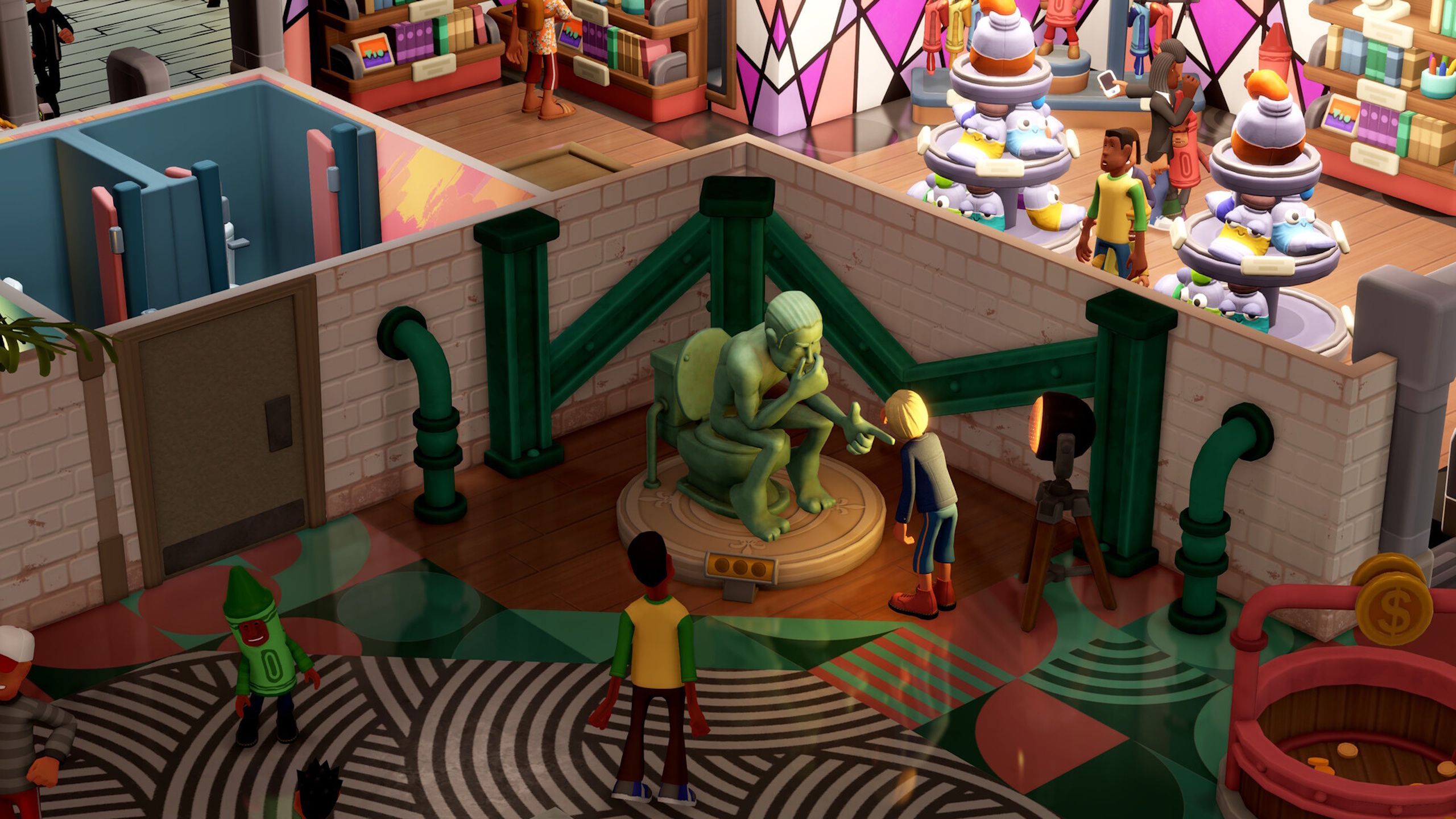
Those ideas became more elaborate in Museum, where staff traits, connected events and the possibility of characters dying during dangerous expeditions added greater narrative consequence.
Community feedback could also require changes to an existing game. Museum initially featured a security system influenced partly by real-world art thefts the developers had heard about during production. Players could spend time designing a museum only to see it dismantled by thieves, prompting the team to rebalance the system.
The studio has grown from 14 employees at the launch of Hospital to 50 people, supported by carefully selected external teams for specialist work. Its leadership has deliberately resisted adding layers of management, having seen rapid expansion damage workplace culture at larger companies.
Two Point’s founders remain committed to staying involved in development rather than moving entirely into management. For them, keeping the team compact protects the hands-on, collaborative way of working that made the studio possible.
That balance between detailed simulation and approachable design is central to Two Point’s appeal. Players found games that offered meaningful complexity without becoming exhausting, alongside humour that did not make the systems feel shallow. A decade after the studio’s formation, that middle ground remains remarkably uncommon.
For more coverage of the wider arcade and gaming industry, explore RETROCADE’s editorial archive. Readers considering a dedicated gaming setup can also consult the Arcade Machine Buying Guide, browse full-size arcade machines or compare space-saving bartop arcade cabinets.


Leave a Reply