



Emma Frost’s Long Road from X-Men Villain to Hero

With Samara Weaving reportedly cast as Emma Frost for the next era of Marvel’s X-Men films, one question matters immediately: will the character be introduced as a villain, an ally, or something more complicated?
Emma has one of the more substantial redemption stories in superhero comics. She began as a powerful enemy of the X-Men, but years of loss, responsibility and reluctant cooperation eventually turned her into a teacher, an antihero and a frontline member of the team.
This is a streamlined guide to Emma’s major comic-book milestones, followed by a look at how sharply the film version has differed. Readers wanting the complete story should start with Grant Morrison’s New X-Men run, among Emma’s most important appearances, which is available through Marvel Unlimited.
Emma Frost’s beginnings

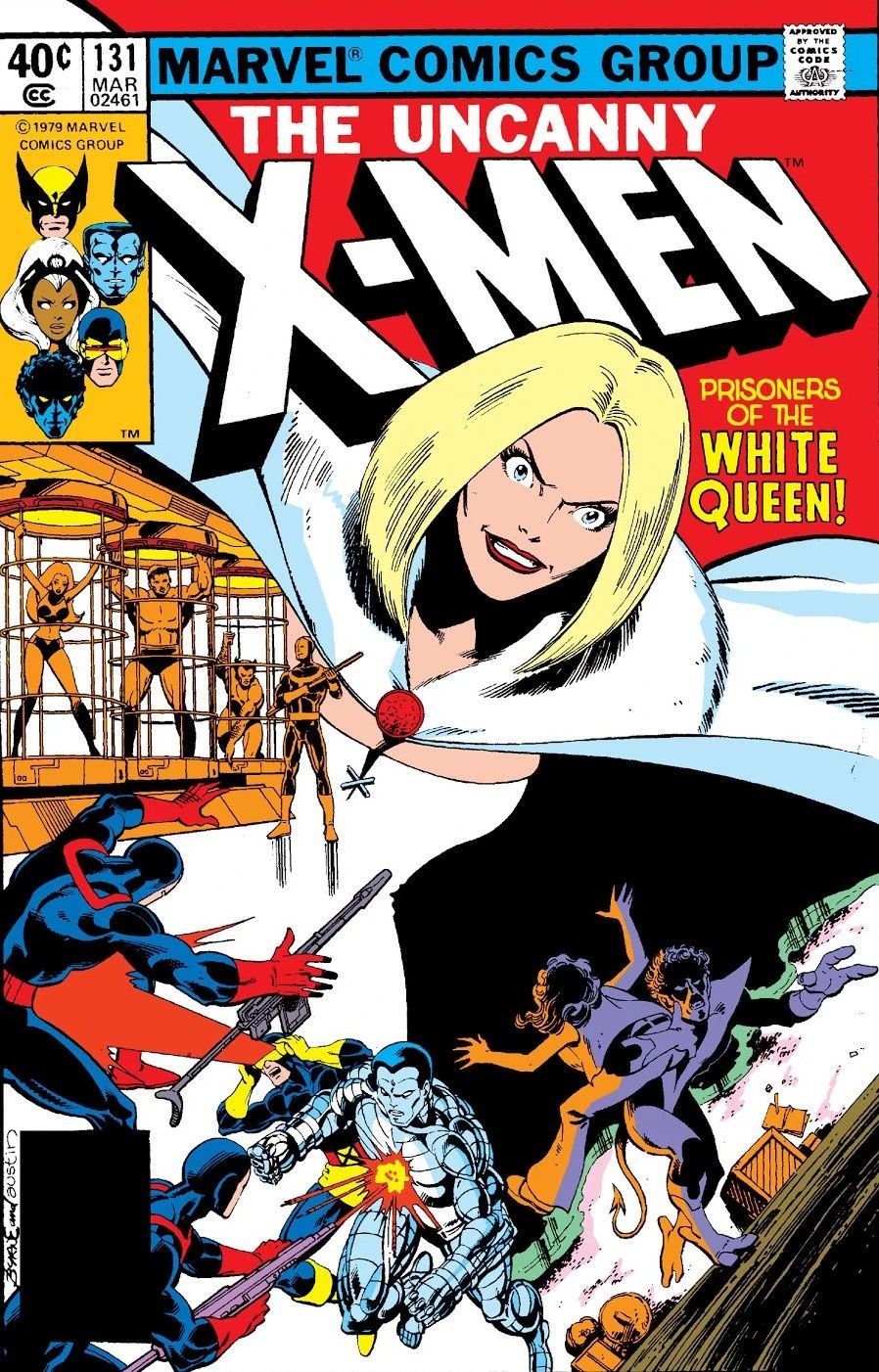
Emma first appeared in Uncanny X-Men volume 1, issue 129, published in 1979. The issue also introduced Kitty Pryde, Sebastian Shaw and Marvel’s Hellfire Club.
The Hellfire Club is a secretive New York society for extraordinarily wealthy members. Its Inner Circle uses chess-inspired titles, including Black King and White Queen. Marvel’s version drew its name from a fictional club in a 1966 episode of the British television series The Avengers, which in turn referenced real 18th-century secret societies.
Emma was born in Boston, one of four children raised by Winston Frost, an old-money billionaire, and Hazel Frost. Winston abused all four children. Emma was initially shy and isolated, with ambitions of becoming a teacher.
Every Frost child eventually manifested mutant abilities. Emma’s telepathy emerged during an angry outburst at boarding school that rendered everyone around her unconscious. Charles Xavier noticed her potential before founding the X-Men, but Emma and her father rejected his invitation to attend his school.
Once she understood her powers, Emma left home. After a short period at college, she changed her hair, underwent cosmetic surgery and worked as a stripper in New York. A job at the Hellfire Club introduced her to Shaw, a fellow mutant. They quickly formed an alliance, seized control of the club and declared themselves the Black King and White Queen.
The White Queen
The Hellfire Club’s elaborate period clothing reflected its rejection of ordinary social morality. Shaw viewed mutants as assets to control, especially young mutants who could be recruited as servants and soldiers.
Emma became the club’s instrument against the X-Men. When the team travelled to Chicago to meet Kitty Pryde after her powers appeared, Emma attacked with heavily armed mercenaries. She won the initial confrontation, but Phoenix defeated her in a telepathic battle. Emma was then believed to be dead for a time.
From headmistress to X-Man
Emma eventually returned as headmistress of the Massachusetts Academy, a school funded by Shaw. She trained a young mutant team called the Hellions and sometimes attempted to lure students away from Xavier’s school.
That life ended when the time-traveller Trevor Fitzroy attacked the Hellfire Club and killed most of the Hellions. Emma nearly died and remained in a coma for roughly a year.
After waking, Emma helped oppose the alien Phalanx, whose plans threatened the next generation of mutants. She later reopened the Massachusetts Academy as a branch of Xavier’s school, establishing the setting for the 1990s comic Generation X. That series was also adapted into a 1996 television film starring Finola Hughes as Emma.
Emma then moved to Genosha, the newly established mutant nation, where she taught young telepaths. She was teaching when a new type of Sentinel attacked. Emma survived only because she developed a secondary mutation that transformed her body into organic diamond.
Later interpretations, including X-Men: First Class and Marvel Rivals, treat the diamond form as a central part of Emma’s abilities. In the comics, however, it was not part of her original power set.
Seeking revenge against those responsible for Genosha, Emma joined the Xavier Institute. She became both an X-Man and a teacher, and later entered a relationship with Scott Summers that lasted nearly 20 years in real-world publication time. The relationship appears to have ended shortly before the Krakoan era.
For readers interested in the wider arcade side of Marvel’s history, the RETROCADE Arcade Blog covers classic gaming stories and industry news.
Emma Frost on screen

Emma’s film history is considerably shorter. She appeared in X-Men: First Class, set in 1962, where she met Shaw before encountering Xavier and immediately embraced his belief in mutant supremacy.
Emma supported Shaw’s plan to trigger World War III and use the conflict to establish mutant dominance. After Shaw died, Magneto recruited her into his Brotherhood. The following film, Days of Future Past, established that Emma had been killed in 1963, apparently by Bolivar Trask.
The major difference between the comic and film versions is Emma’s relationship with young mutants. In the comics, teaching becomes central to her identity. Although she spends years as a formidable villain, the deaths of the Hellions help push her towards antiheroism. The film version remains a direct mutant supremacist and manipulator, with no comparable teaching career or redemption arc.

What could the MCU do with Emma?
Emma’s divided history makes her unusually flexible. She could oppose Xavier as a ruthless telepath and rival educator, work beside Magneto, or join the X-Men after a period of self-interest and manipulation.
She has also appeared as a member of Magneto’s Brotherhood in other continuities, including the 1992 Konami X-Men arcade game. That precedent leaves the door open for a more conventional villainous interpretation.

The most dramatic possibility would draw on the Morrison-era relationship between Emma, Scott Summers and Jean Grey. That storyline involved telepathic infidelity, elaborate seduction and time travel, making it one of superhero comics’ strangest love triangles.
Whether the new films pursue that material remains unknown. A version of Emma who begins as an adversary, becomes a protector of young mutants and eventually earns a place beside the X-Men would, however, finally bring her most rewarding character journey to the screen.
Planning a dedicated gaming space for superhero beat-’em-ups and other classics? RETROCADE’s Arcade Machine Buying Guide can help compare cabinet formats, while bartop arcades offer a compact option for Australian homes. For restorations and control-panel work, browse arcade parts.


Leave a Reply