


Patlabor 2: The Movie remains one of mecha anime’s most unsettling achievements. Rather than treating giant robots as simple weapons or heroic toys, Mamoru Oshii’s 1993 film uses them to examine political fear, surveillance and the fragile fiction of peacetime.

Masami Yūki’s Mobile Police Patlabor franchise has always stood apart from more straightforward robot stories. Its Labors are practical machines used for construction, policing and other civilian work, while the Patlabors operated by Tokyo’s Special Vehicles Section 2 give the series its distinctive blend of workplace drama, action and social commentary.
The property has grown into a substantial media franchise, including an anime series, two OVAs, three films and a broad range of merchandise. It is also entering a new phase with the Patlabor EZY trilogy. The first entry, Patlabor EZY: File 1, opened in Japanese cinemas on 15 May.

A grounded world of working machines
Oshii’s first Patlabor film, released in 1989, established a Tokyo reshaped by a huge redevelopment project. At its centre sits the Ark, a man-made island that supports the city’s construction efforts. In this setting, Labors are not exclusively military hardware: many are industrial machines designed to move heavy materials and build the future.
That practical role makes the opening crisis especially effective. During a typhoon, thousands of Labors activate because of faulty software, threatening a city-wide disaster. Officers Noa Izumi and Asuma Shinohara respond in their police mechs, combining emergency services procedure with the visual spectacle of giant robots.
For readers exploring the machinery and controls behind classic arcade hardware, RETROCADE’s arcade parts collection offers a useful reminder that interactive machines are defined as much by their practical components as by their screens.
When the sequel turns from robots to politics
Patlabor 2: The Movie moves the story to 2002, where political instability follows a sudden military takeover of Tokyo. Demonstrations spread through the capital, and blame falls on factions including the Japan Air Self-Defense Force after a missile destroys the Yokohama Bay Bridge.
As the situation deteriorates, Section 2 officers Kiichi Goto and Shinobu Nagumo assemble a team to confront the terrorist threat. Yet the film is less interested in presenting a conventional robot battle than in showing how institutions manufacture uncertainty, shift responsibility and justify increasingly forceful responses.

Many mecha series use futuristic hardware to discuss real-world conflict. Mobile Suit Gundam explores the human cost of seemingly endless war, while Code Geass: Lelouch of the Rebellion focuses on imperial oppression and the unexpected origins of rebellion. Patlabor 2 takes a quieter route, placing bureaucratic power and military tension ahead of battlefield heroics.
The disturbing idea at the film’s centre
The film’s most prescient idea is that peace can be an illusion. Japan appears stable, but that stability depends on ignoring proxy conflicts and violence elsewhere. Oshii examines a post-war society that enjoys security while remaining entangled in international tension, creating a Cold War-like “pseudo-peace” that cannot withstand a carefully engineered shock.

That political focus explains why the Patlabors often feel secondary. The story’s real conflict takes place between the police, the military and the systems that govern them. Corruption is rarely presented as a single villain’s fault; instead, it emerges through layers of procedure, secrecy and institutional self-preservation.
The result is a disturbing form of state-surveillance commentary. The danger is not only an attack or a missile, but the willingness of ordinary people and officials to accept expanding security measures when they are frightened enough.

Mamoru Oshii’s atmosphere of alienation
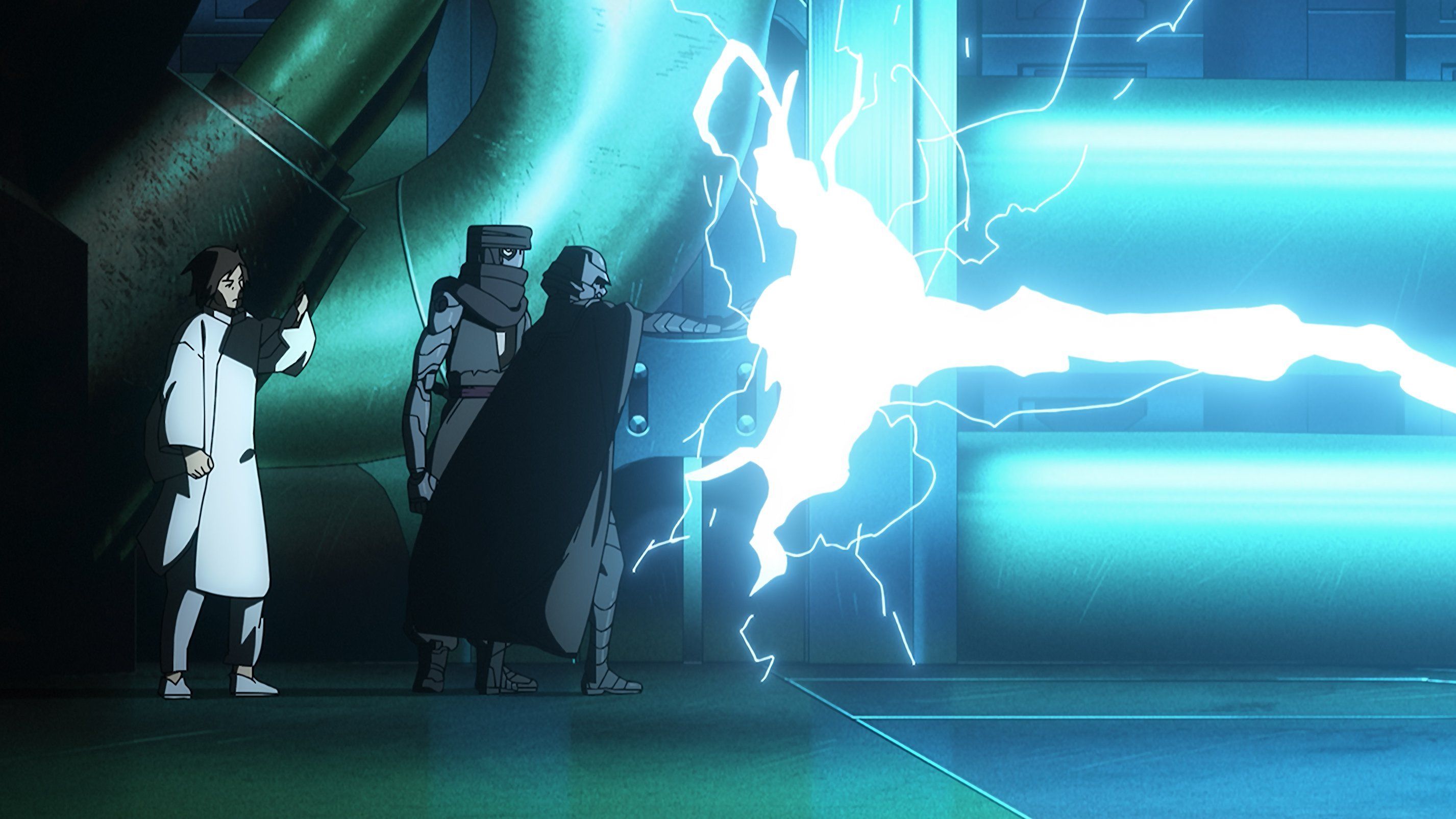
Oshii’s visual approach reinforces the film’s political unease. The muted palette, imposing cityscapes and meticulously detailed backgrounds make Tokyo feel both recognisable and strangely artificial. The city is busy, but emotionally distant; its public spaces seem designed to conceal rather than reveal what is happening underneath.
Oshii would later become widely associated with the distinct aesthetics of Ghost in the Shell (1995), while his earlier work included Angel’s Egg (1985). Those interests in identity, technology and isolation are already visible here, particularly in the film’s long pauses and dreamlike transitions.

There is still room for spectacular mecha action, but Patlabor 2 is at its strongest in command rooms, corridors and quiet surveillance spaces. The tension comes from watching people look directly at corruption and decide that acknowledging it would be more dangerous than allowing it to continue.
Why its themes feel current again
The newer Patlabor EZY: File 1 shifts the setting to the 2030s, when AI automation has made Labors and Patlabors obsolete. Special Vehicles Section 2 survives, continuing to protect the city in an era where technology has become both essential and threatening.

This time, the threat is not defined by missiles. Technological warfare has become quieter, while automation devalues human labour and contributes to broad social and political instability. Surveillance is no longer necessarily an obvious intrusion; it can be woven into daily life so thoroughly that its presence becomes difficult to separate from convenience.
That imagined future changes the franchise’s anxieties without abandoning its central concern. In 1993, technology could turn war into an impersonal statistic. In the newer story, automation raises a related question: what happens when efficiency itself begins to erode human agency?

A lasting recommendation for mecha fans
Patlabor 2: The Movie was released in cinemas on 7 August 1993 and remains the high point of the franchise for many viewers. Its importance does not depend on constant action or elaborate robot specifications. The film’s power comes from its refusal to separate futuristic machinery from the institutions and ideologies that control it.
The film is largely unavailable to stream or rent through mainstream services, so legal access is chiefly through physical Blu-ray releases. That limited availability makes it a particularly valuable discovery for anyone interested in thoughtful science fiction, political thrillers or the less commercial side of mecha anime.
For Australian arcade enthusiasts, its central idea also has a familiar ring: machines are never neutral. Their design, software and purpose reflect the people and organisations that build, operate and regulate them. RETROCADE’s arcade machine buying guide explores the practical decisions involved in choosing a cabinet, while the arcade blog covers the wider culture surrounding these machines.

Whether viewed as a police procedural, a mecha film or a warning about manufactured security, Patlabor 2 still feels remarkably sharp. Its bleakest insight is that the most disturbing future may not arrive with an army of robots, but through the quiet normalisation of systems that make violence, surveillance and human loss easier to ignore.


Leave a Reply