


Warning: spoilers for Jean DeWolff’s comic-book history.
One of the most meaningful Easter eggs in Spider-Man: Brand New Day reaches back more than four decades to a relatively minor Marvel character: NYPD Captain Jean DeWolff.
Jean has been dead in Marvel continuity since 1985, yet she has remained an unusually persistent presence. Versions of the character have appeared in the Spider-Man Noir comics, Spider-Gwen’s universe, The Spectacular Spider-Man (2008), The Amazing Spider-Man 2 video game and Marvel’s Spider-Man (2017), among other adaptations.
She now makes her Marvel Cinematic Universe debut in Spider-Man: Brand New Day, played by Liza Colón-Zayas, known for The Bear. Jean is presented as a friend of Peter Parker who works with the NYPD, making the reference especially significant for readers familiar with her most famous story.
For more superhero and games coverage, explore RETROCADE’s arcade news and gaming blog.
Who is Captain Jean DeWolff?
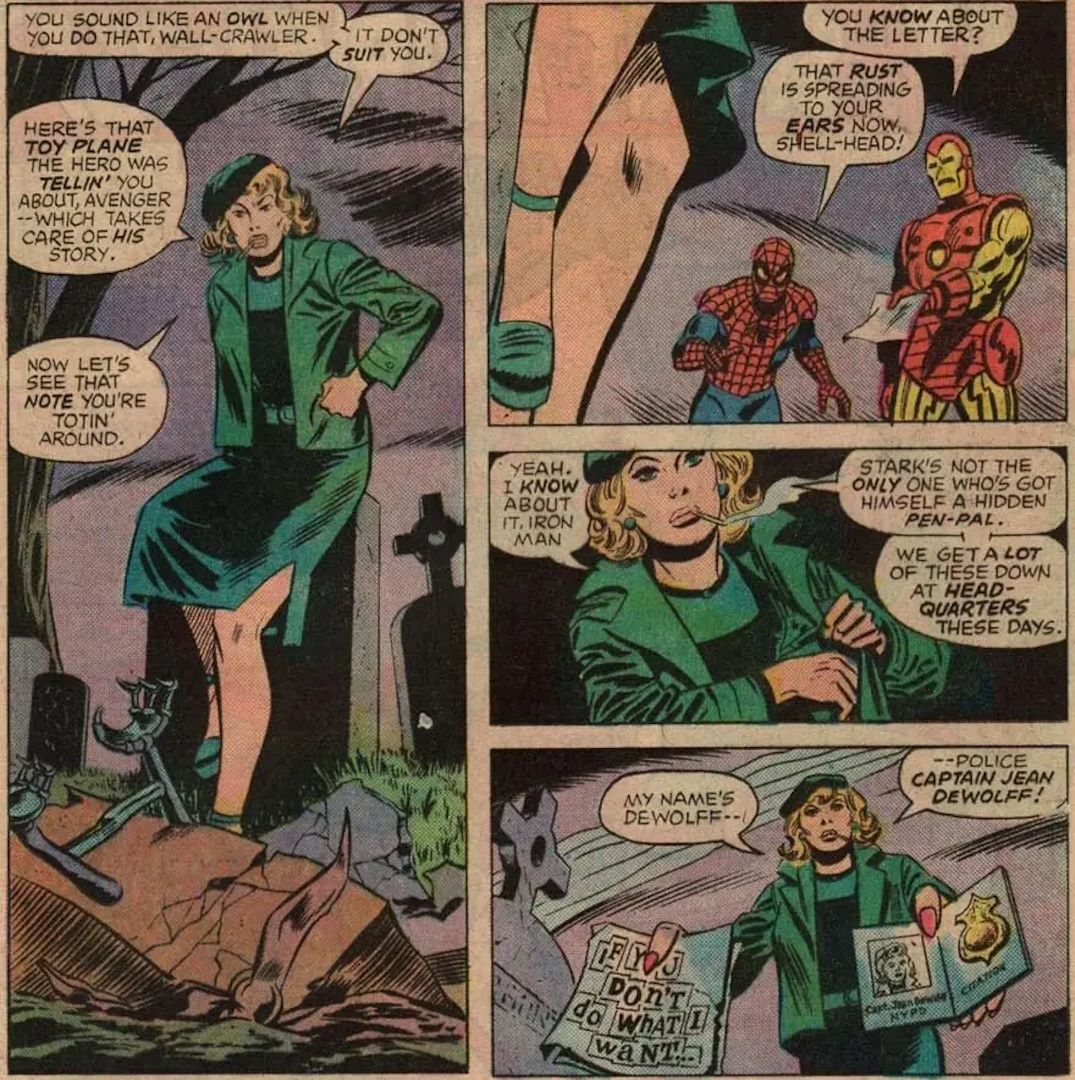
Bill Mantlo and the late Sal Buscema introduced Jean DeWolff in Marvel Team-Up #48, published in 1976. In the story “A Fine Night for Dying!”, the NYPD captain investigates a series of bombings and crosses paths with both Spider-Man and Iron Man.
Later issues of Marvel Team-Up established Jean as Spider-Man’s unofficial police liaison. She also appeared in several other Spider-Man titles during the following nine years.
Jean’s distinctive look set her apart. Marvel gave her an unexplained affection for 1930s cars and clothing: she sometimes dressed like a gun moll and drove a 1932 Ford.
The Death of Jean DeWolff

Jean’s supporting role ended abruptly in 1985 with a four-part storyline spanning Peter Parker, The Spectacular Spider-Man #107 to #111. “The Death of Jean DeWolff” was written by the late Peter David, whose later credits included The Incredible Hulk, Supergirl, Aquaman and roughly 100 Star Trek novels. The artwork came from the late Rich Buckler, co-creator of Deathlok.
The opening presents Jean as the first victim of a shotgun-wielding serial killer calling himself the Sin-Eater. Spider-Man and Daredevil eventually capture the murderer, but the investigation leaves lasting consequences for both heroes and the wider Marvel Universe.
The storyline was later collected in a trade paperback under the same title. Its crime-focused, noir-influenced approach is an often-overlooked example of the darker, “grim and gritty” style associated with the post-Watchmen era. David and Buckler drew on the kind of hard-edged storytelling Frank Miller had recently brought to Daredevil.

Compared with the issues immediately before it, the arc is a striking change of direction. The comic moves from conventional superhero action into an urban crime drama set against an ’80s New York that feels close to collapse. Peter becomes a driven investigator, essentially taking on the role of a Mike Hammer-style detective.
The story also marks the first time Peter Parker and Matt Murdock discover each other’s secret identities. That reveal may seem less momentous now, when so many Marvel characters know Spider-Man’s identity, but it was a major development in 1985 and shaped both characters’ stories for years.
The Sin-Eater case also helped create Venom’s backstory. In Amazing Spider-Man #300, readers learned that journalist Eddie Brock had damaged his professional reputation by publishing a story claiming to know the Sin-Eater’s identity. Brock had identified a copycat rather than the real killer. Spider-Man’s eventual capture of the genuine Sin-Eater left Eddie disgraced and began the downward path that led to Venom.
Jean DeWolff’s continuing influence

Although Jean’s death was an early example of the storytelling pattern later described as fridging, the character was never completely forgotten. Later Spider-Man creators continued to reference her, helping Jean develop a cult following despite her comparatively small number of appearances.
Marvel even briefly resurrected Jean as part of the 2016 Clone Conspiracy storyline, which brought several deceased supporting characters back to life for a short period.
Her influence can also be seen in Yuri Watanabe. Introduced in the Spider-Man comics in 2009 as an NYPD police captain, Yuri was eventually revealed to have been a friend of Jean’s. Her connection to Jean helped explain Yuri’s sympathy towards superheroes, particularly Spider-Man.
Yuri later became a significant figure in Insomniac’s Spider-Man universe, both as part of the supporting cast and through her costumed identity, Wraith. Players interested in exploring more superhero gaming can browse RETROCADE’s arcade machines or compact bartop arcades.
Why the Easter egg matters
You do not need Jean DeWolff’s full history to follow Spider-Man: Brand New Day. However, her inclusion connects the film to an influential 1980s Spider-Man crime story, the early relationship between Peter and Daredevil, Venom’s origin and a long line of comic and game adaptations.
For an obscure supporting character with a limited original run, Jean has left an unusually durable mark on Spider-Man lore. Spider-Man: Brand New Day is playing in theatres.


Leave a Reply